Are German voters economically illiterate or irrational?
Maybe less than you might think
The results of the elections in three of Germany’s federal states (“Länder”) have sent shock waves through the political establishment. In Saxony-Anhalt, the right-wing Alternative für Deutschland (AfD) won almost half of the seats and might well be able to have its candidate elected as prime minister. In Berlin, the Left Party became the largest party and might, for the first time, name the city’s mayor. In Mecklenburg-Western Pomerania, the Christian Democrats missed the 5 percent threshold and lost their representation in the state legislature—a first for a state parliament in the 75-plus-year history of the Federal Republic of Germany.
In response, Chancellor Friedrich Merz took responsibility for possible weaknesses in his communication style, but at the same time reaffirmed his commitment to seeing through the reforms he had promised over the past months. Lars Klingbeil, chairman of the Social Democratic Party and finance minister, stated that one might discuss parts of the reform packages, but stopped far short of questioning the overall course of the government’s economic policy.
In a way, both Merz and Klingbeil seemed disappointed and even a bit offended by their voters’ reaction. Had they not pushed forward necessary reforms? Why were voters punishing them now for their efforts?
A simple explanation is that necessary reforms are seldom popular and that the electorate is now punishing the governing parties for doing the economically right thing.
However, my take would be slightly different. While I despise the AfD, I would give voters much more credit for their reaction at the ballot box.
True, the German economy is in dismal shape. Manufacturing in particular is suffering. Manufacturing production is running 15 percent below its 2018 peak. Since then, 400,000 manufacturing jobs have been lost, and further job losses are an ongoing concern in many regions of Germany. The U.S. and China are pulling away in the area of artificial intelligence and investing billions while Germany lags behind.
Despite these problems, on closer inspection, the reforms do not seem to be aimed at addressing them. According to our research at the IMK (Macroeconomic Policy Institute), three main factors are behind Germany’s manufacturing crisis: aggressive Chinese industrial policy, U.S. tariffs, and increased energy prices following Russia’s invasion of Ukraine.
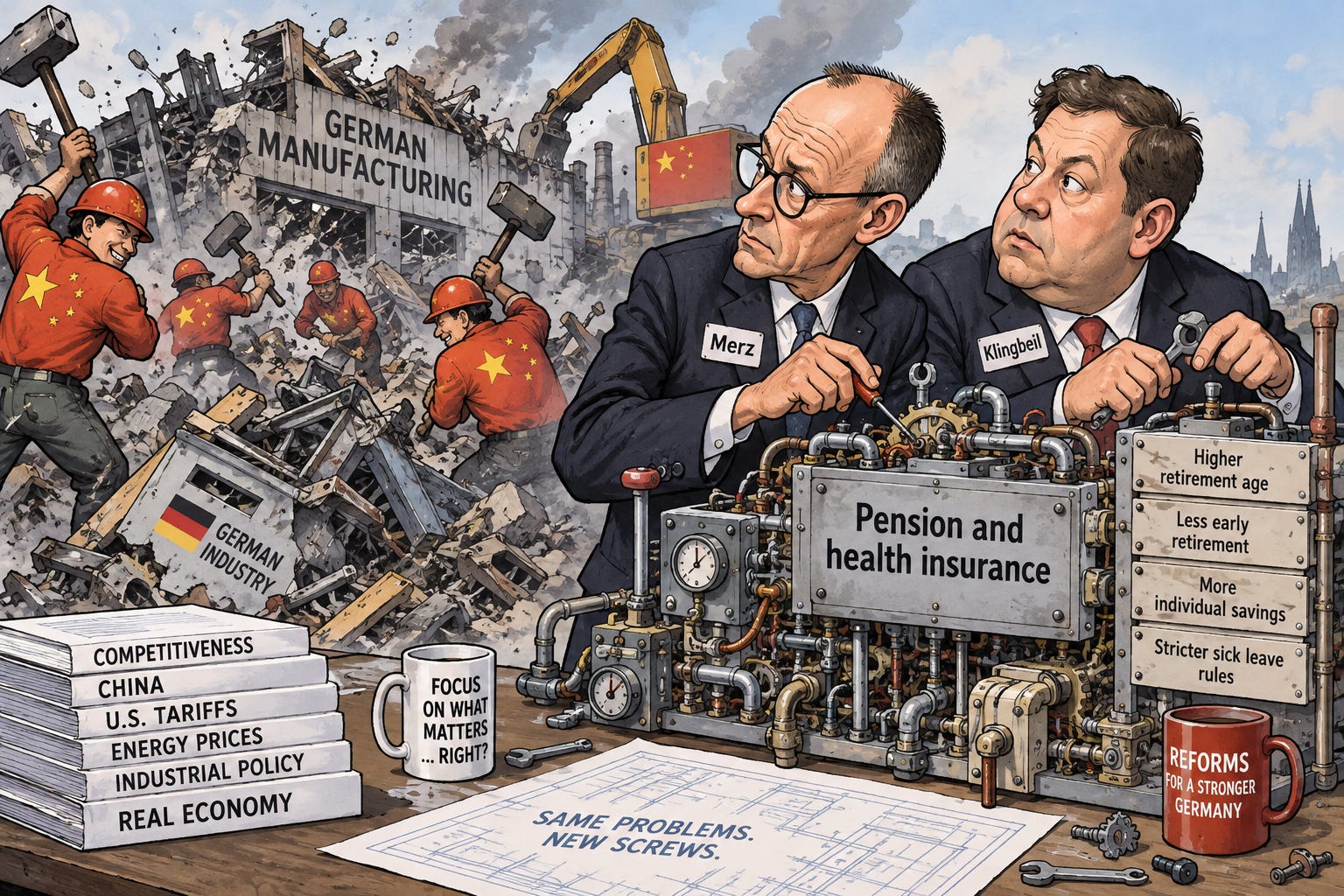
China already stated in its “Made in China 2025” strategy (published in 2015) that it aimed to become a technology leader, become independent of foreign technology, and strongly increase exports in key manufacturing sectors. After a decade of bold industrial policy, including heavy subsidies, it has reached many of its targets. Tragically, many of the areas targeted are areas in which Germany used to be strong.
As a consequence, Germany has lost market share in China (which went from being Germany’s second-largest export market in 2020, just behind the United States, to number nine, behind Austria, Switzerland, and Poland, in the first half of 2026). It is now confronted with subsidized Chinese competition both in its home market and in third markets.
In the U.S. market, Trump’s tariffs have made business very difficult for German companies.
Both problems are aggravated by the fact that natural gas prices are currently about 400 percent above their level prior to Russia’s invasion of Ukraine (just shy of €80 per MWh, compared with €20 per MWh prior to Covid).
The German government has not provided a single plausible solution to these challenges. The reform packages under discussion increase the retirement age after 2031 (it is already set to increase gradually until then), make early retirement less attractive, and force people to save in a capital-based scheme from 2028 onwards. They also include measures to reduce employment protection for those earning more than €177k annually and require everyone to provide a doctor’s certificate from the first day of illness onwards (until now, the standard was for absences of more than three days, with employers being allowed to ask for a certificate earlier).
Of course, demographic change is real. But relative to the geoeconomic challenges, it is not the most pressing problem for the German economy.
The other elements of the reform package are annoying, but they do not promise any economic growth, and certainly not an answer to the Chinese challenge. Their impact on labor costs is predictably marginal at best. Also: If the government in Beijing has decided that it does not want Western cars sold in its domestic market anymore, who really thinks that a cut in labour costs of one or two percent in Wolfsburg would change the sales numbers of German cars in China?
It is thus not surprising that none of the leading German economic research institutes (and none of the leading private-sector economists I follow) has increased its growth forecast because of these reforms (they have increased their forecasts because of past data revisions, though).
It might be true that bold and effective reforms hurt a significant share of the population. However, from this, you cannot conclude that reforms that hurt a lot of people are necessarily effective. Yet this seems to be exactly the kind of logical error the government is making here.
In a number of discussions with senior policymakers in the first half of the year, when I questioned the specific economic logic of some of their policy proposals, I repeatedly heard the claim that “we need to demonstrate our ability to take action.” According to their analysis, potential AfD voters were frustrated by the political system’s inability to implement change.
For me, this was always a strange interpretation: Who would want change for change’s sake, especially if change comes with personal costs? Not even AfD voters would be that stupid.
At the IMK, we conducted surveys on the population’s acceptance of reforms to public pensions, the health system, and the labour market. The result (see figure below): A majority of the population opposes the current reforms both as a package and individually. Crucially, the strongest opposition was actually voiced by those stating their intention to vote for the AfD and the Left Party. Even among Christian Democratic voters, a majority did not approve of the reforms.
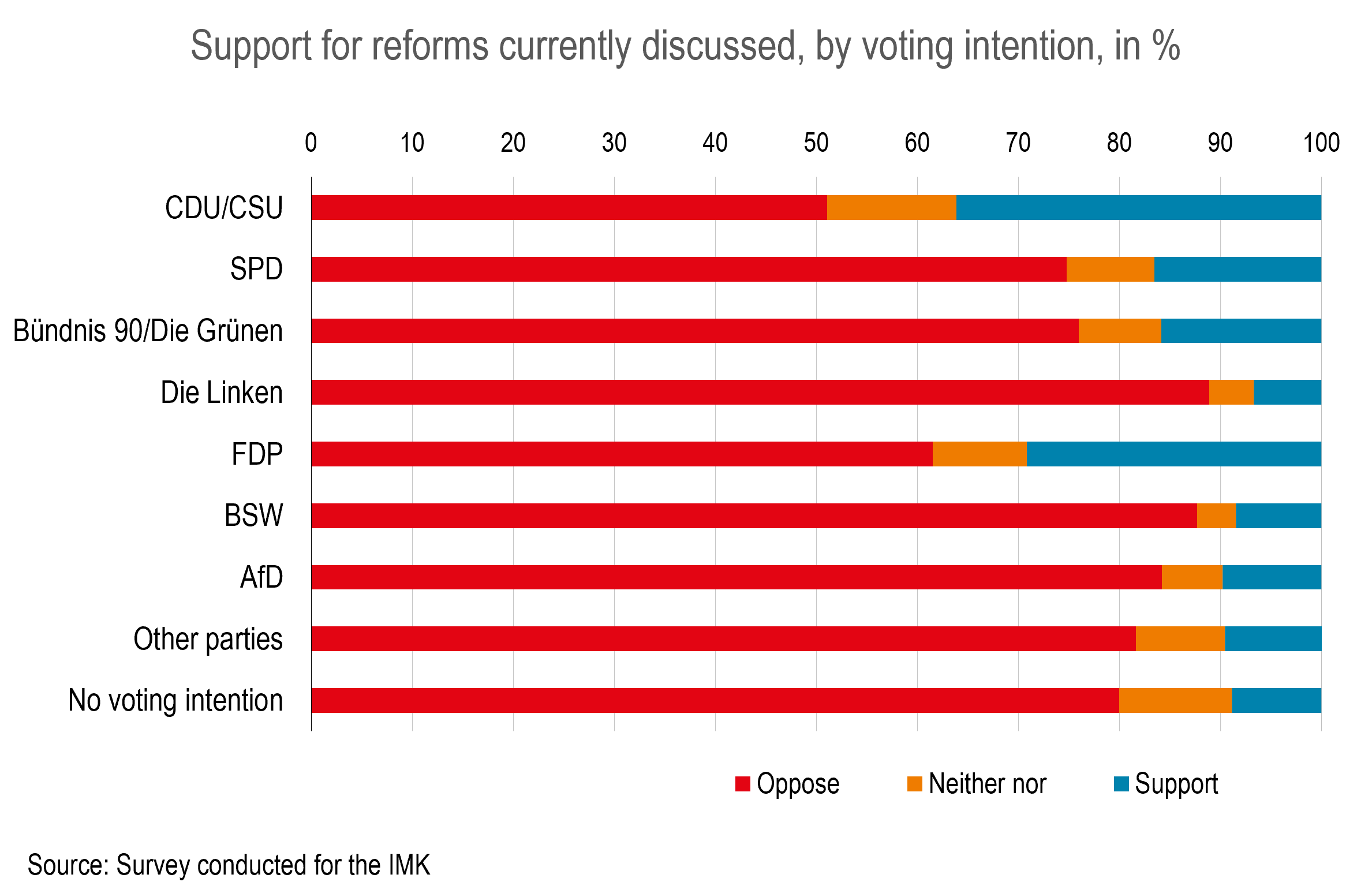
Hence, one could also interpret the election results as a genuine protest against the reforms and, especially, against the dissonance between the perceived problems of the German economy and the proposed solutions.
Of course, voting for the AfD clearly is not a solution to any of Germany’s economic woes and might well make things worse. Yet, if the mainstream does not offer a solution that is plausibly in line with perceived real-world problems, an incoherent right-wing programme might suddenly seem more appealing.